
Disclosure: SmartHomeUK participates in the Amazon Associates programme and other affiliate schemes. Links marked with (affiliate) may earn us a commission. This never influences our editorial judgements.
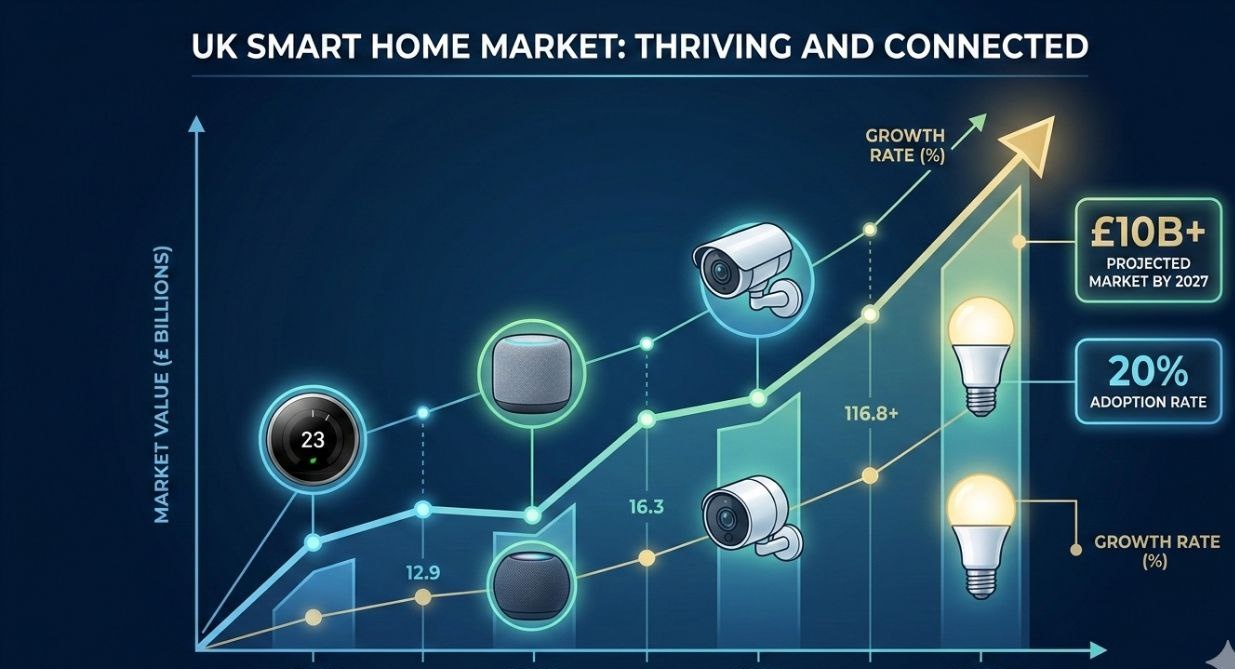
UK Smart Home Statistics 2026: The Numbers That Matter
These are the products UK homeowners are buying most — all tested, all with Amazon affiliate links:
- tado° Smart Thermostat V3+ — Best smart thermostat, from £129.99 → Full guide
- Amazon Echo Show 8 — Best smart display, from £89.99 → Full guide
- Meross Smart Plug — Best smart plug, from £13.99 → Full guide
- Eufy Video Doorbell E340 — Best video doorbell (no subscription) → Full guide
- Roborock S8 — Best robot vacuum, from £449 → Full guide
More than 28 million UK households now have access to at least one internet-connected device in their home — and the gap between early adopters and the mainstream is closing fast. The UK smart home market is on a trajectory to nearly double in value before the end of the decade, driven by rising energy costs, maturing interoperability standards, and a generation of renters and homeowners who’ve grown up expecting their homes to be as connected as their phones.
This article compiles the latest UK smart home statistics for 2026: market size, adoption rates, the most popular devices, energy savings, privacy concerns, and what the next four years are likely to bring. Whether you’re a consumer, investor, or just curious where the market stands, here’s the data.
Looking for a broader overview of the best setups on the market right now? See our guide to the best smart home systems in the UK for 2026.
UK Smart Home Market Size 2026
Current Market Valuation
The UK smart home market is valued at approximately £5.8 billion in 2026, according to data from Statista and Mordor Intelligence. This represents a compound annual growth rate (CAGR) of around 11.4% since 2022, when the market sat closer to £3.7 billion.
The UK is the second-largest smart home market in Europe, behind Germany (estimated at €8.1 billion), and ahead of France and the Netherlands. Globally, the UK represents approximately 4.2% of the worldwide smart home market — punching above its weight relative to population size.
Growth Trajectory
Key forecasts for the UK smart home market:
- 2026: ~£5.8 billion (current estimate)
- 2027: ~£6.5 billion (projected)
- 2028: ~£7.3 billion (projected)
- 2030: ~£9.2 billion (projected, Mordor Intelligence)
The strongest growth segments are smart energy management (driven by the energy price cap environment), smart security, and home health monitoring — the latter driven in part by an ageing population and NHS pressures that are pushing more care into the home setting.
Investment and Retail
Retail sales of smart home devices in the UK exceeded £1.2 billion in 2025, with the Christmas quarter alone accounting for roughly 28% of annual unit volumes. Amazon remains the dominant retailer by volume, with the Echo range and affiliated Alexa-compatible devices dominating shelf space both physically and online. Apple HomeKit-compatible products have seen a 34% YoY increase in UK sales, reflecting growing interest in privacy-first ecosystems.
Smart Home Adoption Rates in the UK
Household Penetration
As of early 2026, approximately 42% of UK households own at least one smart home device — up from 35% in 2024, according to Ofcom’s Connected Nations data and YouGov consumer surveys. That’s roughly 12.2 million homes out of the UK’s estimated 29 million households.
However, the definition of “smart home” matters. If the threshold is owning three or more connected devices operating as a system, the figure drops to around 18% of UK households — approximately 5.2 million homes that could meaningfully be called “smart.”
Demographics: Who’s Adopting?
Smart home adoption in the UK is heavily skewed by age, income, and housing tenure:
- Age 25–44: The highest adoption bracket — 61% own at least one smart home device. This cohort grew up with smartphones and treats connectivity as baseline expectation.
- Age 45–64: 44% ownership — the fastest-growing segment, driven largely by smart thermostats and security cameras.
- Age 65+: 21% ownership — lower overall but with strong interest in voice assistants and remote health monitoring.
- Homeowners vs Renters: 51% of homeowners have smart home devices vs 31% of renters. Renters face permission barriers from landlords, though smart devices that don’t require installation (smart speakers, plugs, bulbs) are bridging the gap. See our guide to smart home for renters in the UK.
- Income: 68% of households with annual income above £50,000 own smart home devices, vs 29% of households earning under £25,000. Cost remains the single biggest adoption barrier.
Regional Variation
Smart home adoption is highest in London (54%) and the South East (49%), with the lowest penetration in Northern Ireland (28%) and the North East (31%). Urban/rural divides are significant: fibre broadband availability and household income are the two strongest predictors of smart home adoption at a local level.
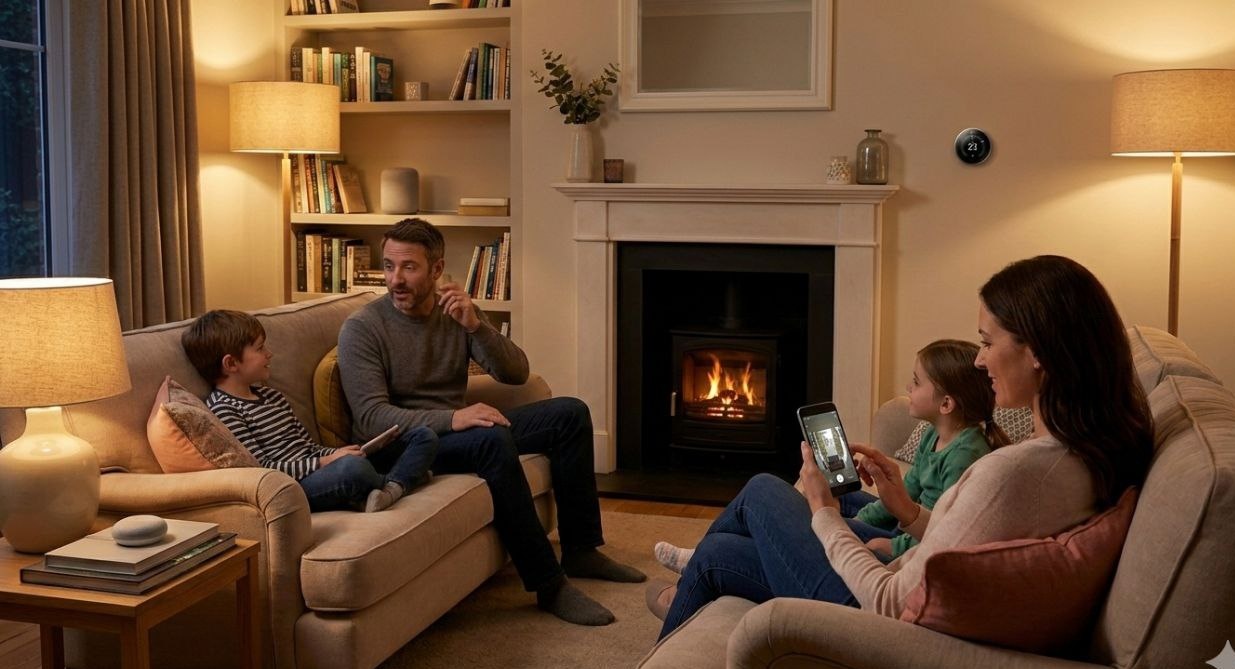
Most Popular Smart Home Devices in the UK
Based on Statista, GfK retail data, and YouGov consumer surveys, here are the most widely owned smart home device categories in the UK as of 2026:
1. Smart Speakers — 29% of UK Households
Smart speakers remain the category entry point for most UK consumers. Amazon Echo holds around 54% of the UK smart speaker market, with Google Nest Audio at approximately 28%, and Apple HomePod at 11%. The remaining ~7% is split between Sonos, Bose, and other brands.
Smart speakers function as the control hub for many UK smart homes — triggering routines, controlling lighting, and integrating with thermostats. See our best smart speakers UK 2026 guide for current recommendations.
Popular picks on Amazon: Amazon Echo (4th Gen) (affiliate) | Google Nest Audio (affiliate)
2. Smart Thermostats — 22% of UK Households
Smart thermostats are the second most popular category, and arguably the most impactful for household finances. The UK market is led by Tado (the largest in Europe), Hive (British Gas), and Google Nest. Hive benefits from British Gas’s installer network; Tado from strong Amazon reviews and Matter compatibility.
Given rising energy costs, smart thermostat adoption accelerated sharply in 2023–2025, and the trend is continuing. Full breakdown in our best smart thermostats UK 2026 guide.
Popular picks: Tado Smart Thermostat Starter Kit (affiliate) | Google Nest Learning Thermostat (affiliate)
3. Smart Security Cameras — 19% of UK Households
Security cameras are the third most popular category, with Ring (Amazon), Arlo, and Eufy leading the UK market. Video doorbells — a subset of this category — are owned by approximately 14% of UK households and have become near-standard on new-build developments.
Popular picks: Ring Video Doorbell 4 (affiliate) | Arlo Pro 5S Camera (affiliate)
4. Smart Lighting — 17% of UK Households
Philips Hue dominates smart lighting in the UK with roughly 41% market share. IKEA Trådfri and TP-Link Tapo bulbs have grown rapidly due to lower price points. Smart lighting is often a gateway purchase — cheap enough to try, visible enough to impress guests, and compatible with most major ecosystems.
Popular picks: Philips Hue White & Colour Ambiance Starter Kit (affiliate)
5. Smart Plugs & Sockets — 15% of UK Households
Smart plugs are the lowest-friction smart home entry point — no installation, no hub required in most cases, under £15 per plug. TP-Link Tapo and Amazon Smart Plug are the UK volume leaders.
6. Smart Locks — 6% of UK Households
Still niche but growing. Yale and Nuki lead the UK market. Adoption is constrained by upfront cost (£150–£300), installation requirements, and renter restrictions. Landlord-friendly keypad locks are a growth submarket.
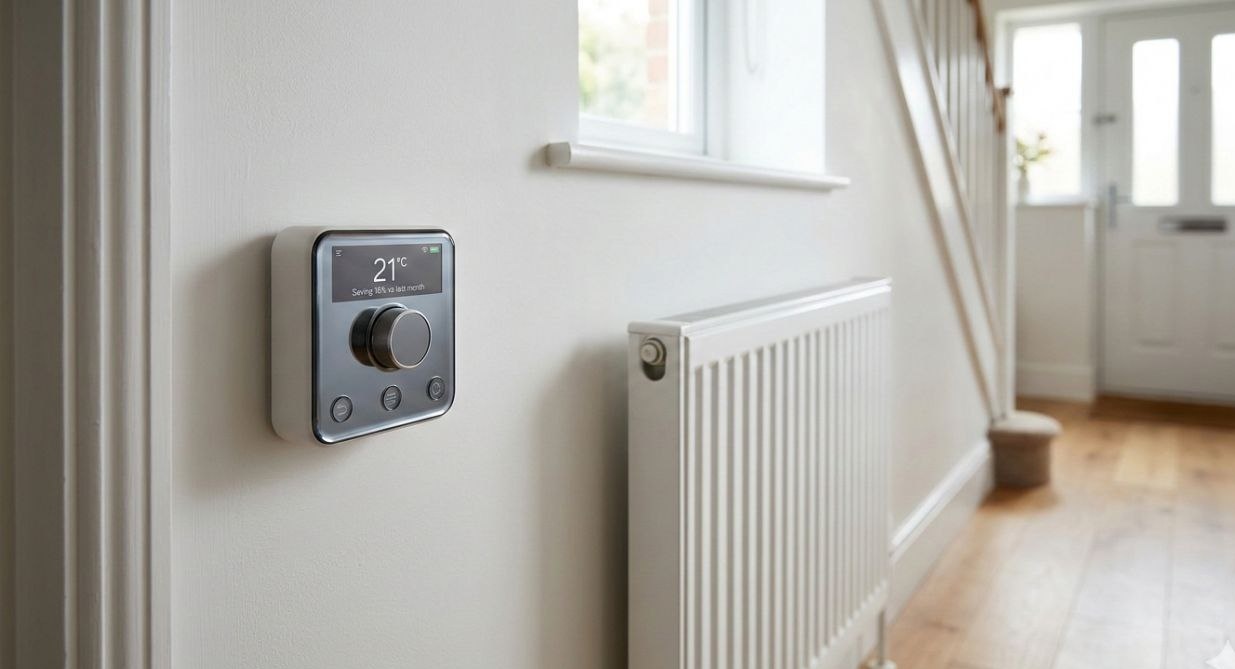
Energy Savings & Cost Impact
The Energy Context: £1,758/Year Price Cap
The Ofgem energy price cap for a typical UK household stands at £1,758 per year as of Q1 2026 (based on average dual-fuel usage). While down from the crisis peaks of 2022–2023, energy costs remain significantly above pre-2021 levels — making energy efficiency technology meaningfully attractive.
Heating accounts for approximately 60–65% of a typical UK household’s energy use (Energy Saving Trust, 2025). This makes smart thermostats the single highest-impact smart home purchase for energy cost reduction.
Smart Thermostat Savings
Independent research, including studies referenced by the Energy Saving Trust and Tado’s own aggregated data from 7 million European users, consistently shows:
- 10–15% reduction in heating energy consumption with a smart thermostat vs a standard programmable thermostat
- Based on £1,758/year total bills and heating at 62% of that (£1,090), a 12% saving = approximately £131/year
- Homes switching from non-programmable thermostats (still ~18% of UK housing stock) can see savings of up to £200–£265/year
- Tado’s geofencing feature — which turns heating off when all occupants leave — delivers an average additional 8% saving on top of baseline smart thermostat effects
Smart Lighting Savings
LED smart bulbs use 75–85% less energy than equivalent incandescent bulbs, but the bigger saving from “smart” specifically is automated scheduling and occupancy-based control. A full smart lighting setup in a 3-bedroom home can reduce lighting energy costs by £35–£60/year.
Standby and Idle Load Reduction
Smart plugs with energy monitoring reveal that UK households waste an average of £55/year on standby power (Energy Saving Trust estimate). Scheduling and remote cutoff via smart plugs can recover 60–70% of this — roughly £33–£38/year from smart plug deployment alone.
Aggregate Smart Home Energy Saving
A fully deployed smart home (thermostat + smart lighting + smart plugs) can realistically save a UK household £200–£350/year on energy bills, depending on baseline habits, home size, and devices. At current device prices, payback periods are typically 12–30 months.
Matter Protocol & Interoperability in the UK
What Is Matter?
Matter is an open-source, IP-based smart home connectivity standard developed by the Connectivity Standards Alliance (CSA), with backing from Apple, Amazon, Google, Samsung SmartThings, and over 550 other companies. It runs over Wi-Fi and Thread, ensuring devices can communicate locally — without cloud dependency.
For a full breakdown, see our Matter smart home protocol UK guide.
Matter v1.4: What’s New
Matter version 1.4, released in late 2025, expands the standard to include:
- Energy management devices — smart EV chargers, solar inverters, heat pumps, and battery storage can now integrate natively with Matter ecosystems
- Water management — leak sensors and valve controllers
- Enhanced bathroom devices — including shower controls
- Improved multi-admin — devices can be controlled by multiple ecosystems simultaneously (e.g., both Alexa and HomeKit)
For UK buyers, the EV charger and heat pump integration is particularly significant. The UK has over 1.3 million EVs on the road and the government’s heat pump targets require mass deployment over the next decade. Matter v1.4 positions smart home ecosystems as central to energy management in these homes.
Matter Adoption in the UK Market
As of 2026, the majority of newly released smart home devices from major brands ship with Matter support. Existing device compatibility via firmware updates has been patchy — Philips Hue, Eve, and Tado have delivered solid Matter updates; some cheaper brands have not.
For UK buyers, the practical advice is: check for Matter certification before purchasing any new device, especially if you’re building a multi-ecosystem home. The Matter logo is now appearing on packaging and Amazon listings.
Thread Border Routers
Thread — the low-power mesh networking layer under Matter — requires a Thread Border Router to function. In the UK, the Apple HomePod mini, Apple TV 4K, Amazon Echo 4th Gen, and Google Nest Hub 2nd Gen all function as Thread Border Routers. If you own any of these devices, your home is already Thread-ready.
Privacy & Security Concerns
The Adoption Barrier
Security and privacy concerns remain the most-cited barriers to smart home adoption in the UK. 34% of non-adopters cite security concerns as their primary reason for not purchasing smart home devices, according to YouGov data. A further 28% cite privacy concerns specifically — particularly around voice assistant data collection and camera footage storage.
Real Risks vs Perceived Risks
The concern is not unfounded. High-profile incidents — including Ring camera data breaches in the US, baby monitor compromises, and revelations about third-party access to smart speaker recordings — have dented consumer confidence. However, the risk landscape in the UK has improved significantly due to regulation.
PSTI Act 2022: The UK’s New Baseline
The Product Security and Telecommunications Infrastructure (PSTI) Act 2022, which came into full force in April 2024, sets minimum security standards for all internet-connected devices sold in the UK:
- Ban on universal default passwords — devices cannot ship with generic passwords like “admin/admin”
- Mandatory vulnerability disclosure policy — manufacturers must publish a point of contact for reporting security issues
- Transparency on security update periods — sellers must state the minimum period for which security updates will be provided
This puts the UK ahead of most markets globally for consumer IoT security standards. Devices that don’t comply cannot legally be sold in the UK.
GDPR and Data Rights
UK GDPR (retained post-Brexit) gives consumers the right to request, correct, and delete personal data held by smart home device manufacturers. In practice, exercising these rights remains cumbersome, but the legal framework exists. Privacy-focused ecosystems like Apple HomeKit — which processes most data locally and requires user permission for cloud access — have grown in appeal precisely because of these concerns.
Practical Steps for UK Smart Home Security
- Use a separate Wi-Fi network (VLAN or guest network) for IoT devices
- Keep device firmware updated — most major brands now do this automatically
- Review which apps have microphone or camera permissions on your phone
- Choose brands that offer local processing options (Home Assistant, Apple HomeKit, Matter local API)
Smart Home Predictions for 2027–2030
Market Growth Continues
The UK smart home market is on track to reach £9.2 billion by 2030. The key growth drivers will be:
- Energy management — as heat pumps, EVs, and solar panels proliferate, intelligent home energy management becomes essential rather than optional
- AI-native devices — the next generation of smart home devices will have on-device AI capable of learning routines, predicting needs, and responding contextually
- Health and ageing — with NHS capacity under sustained pressure, remote health monitoring in the home will become a mainstream category
- New build standards — the Future Homes Standard (expected full implementation 2025–2027) will require new UK homes to be significantly more energy-efficient, with smart controls as standard
Household Penetration Forecast
- 2026: ~42% of households own at least one smart device (current)
- 2027: ~48%
- 2028: ~54%
- 2030: ~65% (Statista base case projection)
The AI Layer
The integration of LLMs and on-device AI into smart home hubs is already underway — Amazon’s Alexa+ and Google’s Gemini-powered Nest Hub represent early deployments. By 2028, expect AI-native home hubs that can reason across all connected devices, manage energy in real time, and interface naturally with residents. This will shift smart home value from automation to genuine intelligence.
Consolidation and Commoditisation
Expect consolidation among smart home platforms and significant price compression in hardware. The smart speaker category has already commoditised (entry-level Echo Dot under £25). Smart thermostats and cameras are on the same trajectory. This will accelerate adoption among lower-income households but compress margins for hardware manufacturers — pushing them toward subscription services and data monetisation.
Renter-Friendly Innovation
With 36% of UK households renting, and many landlords resistant to permanent smart home installations, expect significant product innovation in renter-friendly form factors: no-drill smart locks, clip-on sensors, portable smart displays, and landlord-portable smart thermostats. Policy changes — including potential requirements for landlords to support EPC improvements — may accelerate landlord adoption.
Frequently Asked Questions
How big is the UK smart home market in 2026?
The UK smart home market is estimated at approximately £5.8 billion in 2026, with projections to reach £9.2 billion by 2030. The UK is the second-largest smart home market in Europe, behind Germany.
What percentage of UK households have smart home devices?
As of 2026, approximately 42% of UK households own at least one smart home device. Around 18% have three or more connected devices, qualifying as a ‘smart home’ in the fuller sense.
What is the most popular smart home device in the UK?
Smart speakers (such as Amazon Echo and Google Nest) remain the most widely owned smart home device in the UK, present in roughly 29% of households. Smart thermostats are a close second at around 22% of households.
How much can a smart thermostat save on UK energy bills?
Smart thermostats can save UK households between 10–15% on heating costs annually — roughly £131–£200 per year based on the current energy price cap of £1,758/year. Savings vary based on home size, insulation, and usage habits.
What is the Matter protocol and does it matter for UK buyers?
Matter is a universal smart home connectivity standard backed by Apple, Amazon, Google, and Samsung. Version 1.4 (released 2025) adds support for energy management, EV chargers, and more. For UK buyers, Matter means devices from different brands work together without hubs or workarounds — a major step forward for interoperability. Read our full Matter protocol UK guide.
Are smart home devices safe and private in the UK?
Security and privacy remain the top concerns for UK consumers — 34% of non-adopters cite security as their main barrier. UK-sold devices must comply with GDPR and the PSTI Act 2022, which bans default passwords and requires vulnerability disclosure policies. The UK regulatory framework is among the strongest in the world for consumer IoT security.
Sources
- Statista — UK Smart Home Market Revenue & Forecasts (2025/2026)
- Mordor Intelligence — Smart Home Market Size UK Report (2025)
- Ofcom — Connected Nations UK Report (2025)
- YouGov — UK Consumer Technology Survey (2025)
- Energy Saving Trust — Heating & Energy Use in UK Homes (2025)
- Connectivity Standards Alliance — Matter v1.4 Specification Release (2025)
- DSIT / UK Government — PSTI Act 2022 Guidance (2024)
- GfK UK — Smart Home Device Retail Tracker (2025)
- Tado — European Smart Thermostat User Data (aggregated, anonymised, 2025)
- Ofgem — Energy Price Cap Q1 2026
Statistics sourced from third-party research. Figures are estimates and projections. Always verify current data from primary sources. This article was last updated March 2026 by the Smart Home UK team.
Explore Our Smart Home Buying Guides
Based on the statistics above, here are the most popular UK smart home product categories — all with expert buying guides:
- Best Smart Thermostats UK 2026 — Save up to £265/year on heating
- Best Smart Plugs UK 2026 — From £13.99, instant energy monitoring
- Best Smart Door Locks UK 2026 — Keyless entry done right
- Best Robot Vacuums UK 2026 — Complete buying guide
- Best Smart Security Cameras UK 2026 — Indoor + outdoor picks
- Best Smart Speakers & Displays UK 2026 — Echo vs Nest vs HomePod
- Zigbee vs Matter UK 2026 — Which protocol wins?
Smart Home UK Team — A team of UK smart home enthusiasts who test, review and compare products to help you make better buying decisions. Independent. Honest. No sponsored placements.